Toy demand does not change all at once. It shifts at the edges of the assortment, and importers who read those edges early buy better than those who repeat last year's order sheet. Here is where buyer interest is concentrating in 2026, and what each shift means when you sit down to place a container order with a Chinese factory.
STEM and Educational Play Keeps Widening
Educational play is no longer a niche shelf, it is a buying argument that runs through almost every category. Parents are willing to justify a purchase that teaches something, and retailers use that language on the shelf edge. The practical consequence for importers is that the packaging has to carry the claim: what the toy develops, at what age, and in what kind of play. A construction set described only as blocks sells at one price, and the same set positioned around spatial reasoning and fine motor skills sells at another. Robotics kits, coding-free logic games, magnetic tiles, science and experiment sets and early-learning electronics are the strongest sub-categories, and most of them are produced by factories that can also handle your private label.
Licensed Versus Generic
- Licensed products sell themselves on recognition, but the licence has to be genuine for your territory. A factory offering a famous character without documented rights is exposing you to seizure at customs, not offering you a bargain.
- Generic and own-brand ranges carry a better margin and let you control specification, packaging and price positioning without paying royalties.
- The practical middle ground is a licensed anchor for footfall supported by own-brand volume around it, which is how most independent retailers now build a toy department.
If you sell in the Gulf or in Europe, ask for the licence agreement in writing before you sample. Unlicensed lookalikes are the most common reason a toy shipment gets stopped for reasons other than safety.
Sustainable Materials Move from Claim to Requirement
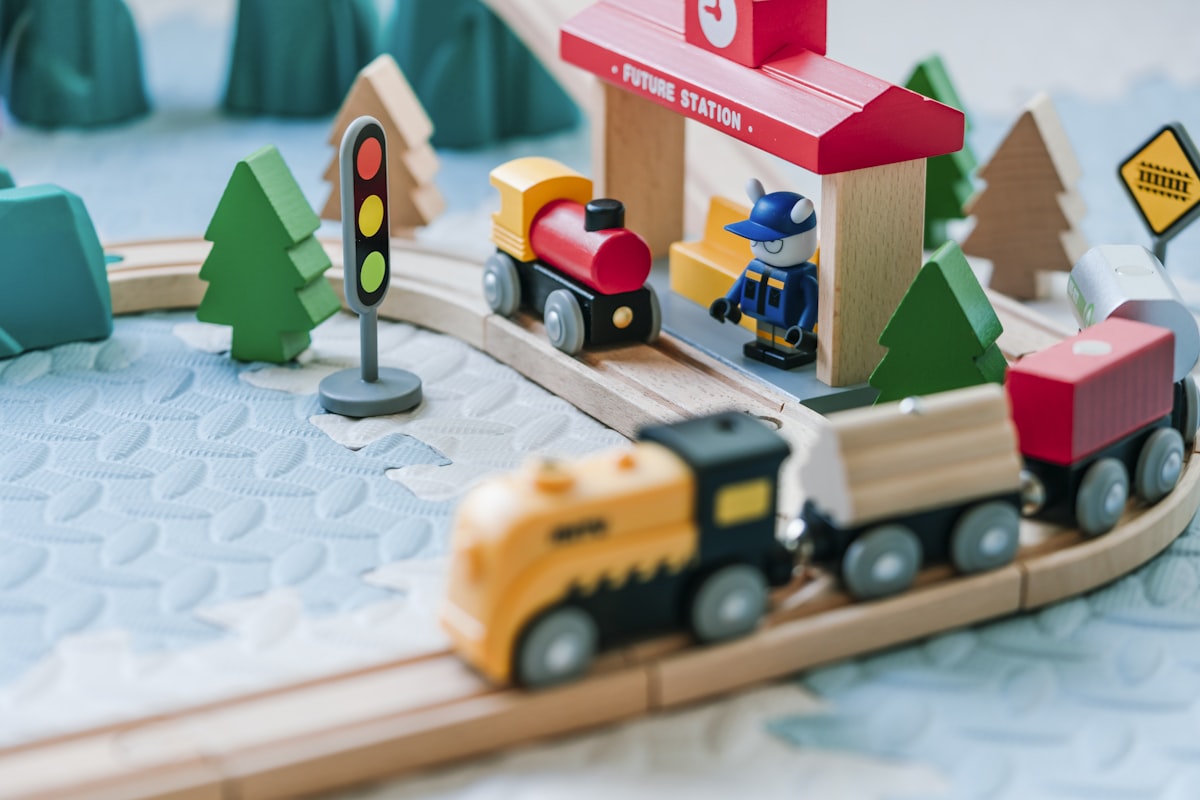
- Wood and bamboo continue to expand in preschool and early-learning ranges, where the material itself reads as a quality signal.
- Recycled and bio-based plastics are increasingly available at production scale, though they need their own testing rather than the certificate for the virgin equivalent.
- Packaging is where the fastest change is happening: plastic-free windows, paper inserts instead of blister trays, and printed cartons that avoid lamination.
- Documentation matters as much as the material. Retail buyers increasingly ask for evidence behind an environmental claim, and an unsupported claim is a regulatory risk in several markets.
RC and Electronic Toys
Remote-control vehicles, drones for older children, interactive plush and light-and-sound preschool items remain reliable volume drivers, and battery and motor quality is the difference between a repeat order and a wall of returns.
- Battery specification: confirm cell type, whether batteries are included, and that button-cell compartments are secured with a screw as required in most markets.
- Charging and safety: rechargeable packs need their own transport documentation, which affects both your freight booking and your customs file.
- Function testing: powered toys need functional checks in the inspection scope, not just visual and dimensional ones.
Seasonality and the Chinese New Year Calendar
The toy calendar is unforgiving, and the Chinese production calendar is the reason.
- Peak retail season concentrates around the fourth quarter and local gifting seasons, so goods must be on your shelves well before demand appears.
- Factories fill their capacity for that season months in advance, and late orders get the leftover slots and the tightest quality margin.
- Chinese New Year stops production for several weeks, with the 2027 holiday falling in early February. Output slows in the weeks before it and ramps back gradually as workers return.
- Ocean transit and destination clearance add further weeks, so a realistic plan counts backwards from your shelf date, not forward from your order date.
In practice this means confirming autumn and winter programmes long before the holiday break, and treating any pre-holiday production promise with healthy scepticism unless the deposit and specification are already settled.
Building the Assortment
- Anchor items: a small number of proven sellers that carry your volume and justify full container economics.
- Margin items: own-brand or exclusive lines where you control the specification and the price is not comparable online.
- Price-point items: impulse and pocket-money products that build basket size and absorb spare container volume.
- Test items: a limited quantity of new concepts each season, ordered small so a failure costs nothing important.
- Age coverage: a deliberate spread across preschool, primary and older children rather than three variants of the same age band.
What to Ask Your Supplier This Year
- Which of these categories the factory actually produces in-house, and which it sources from neighbouring plants.
- What certification exists already for the models you want, and for which market and which standard version.
- What the real production lead time is for your quantity once the deposit clears, and where it sits relative to the holiday break.
- What flexibility exists on minimum order quantity if you want to test several references in one container.
The China Toys consolidates mixed assortments of this kind from a vetted factory base in Guangdong, combining anchor lines, own-brand items and small test quantities into a single container with one compliance file and one inspection, coordinated by an on-the-ground team in Guangzhou. Quotations against your assortment plan are prepared on request.