
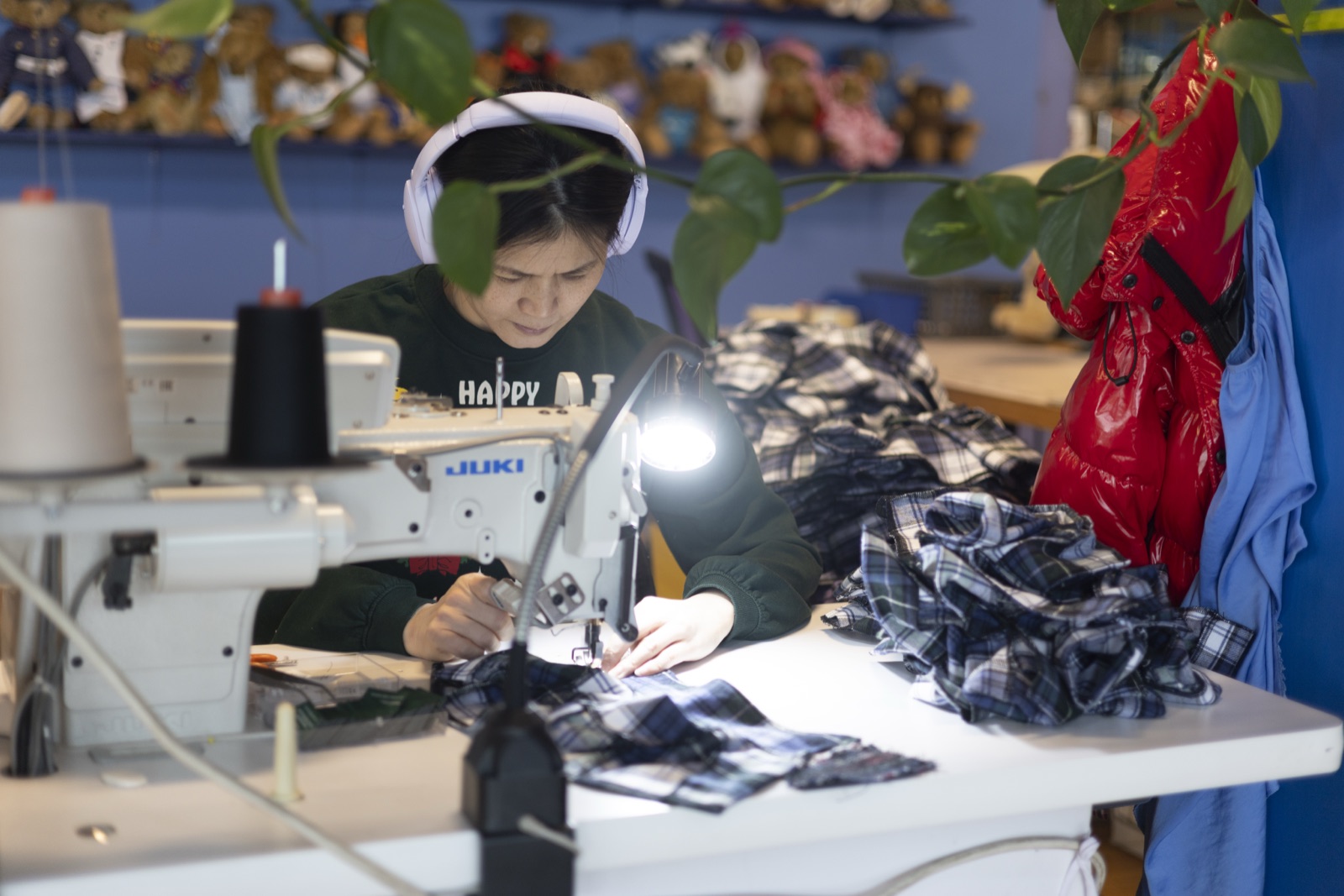
Plush toys are made in China through a fixed sequence of steps: pattern design, fabric cutting, sewing, attaching components such as eyes and noses, filling, hand-closing the stuffing opening, then brushing, cleaning, metal detection and packing. Most production sits in Guangdong, Jiangsu and Anhui provinces. The difference between a good plush toy and a bad one comes down to three decisions made before the first stitch: which fabric, which filling grade, and how the small components are attached.
Which fabrics are used for plush toys?
Almost all modern plush fabric is 100% polyester. What varies is pile length and knit construction:
- Short pile — a smooth, low nap. Best for small toys and detailed shapes, holds embroidery well and picks up less dust.
- Long pile (shaggy) — a premium, dense hand feel. It needs careful brushing after sewing and it exposes cutting mistakes, because the nap direction becomes visible from across a room.
- Minky / super soft — the standard choice for baby and infant plush because of its extreme softness. It is stretchy, so it demands tighter sewing control and a more experienced line.
- Corduroy — a ribbed, crafted look used for classic teddy styles and gift-oriented plush.
Practical rule: the higher the fabric weight in GSM, the fuller and more shape-stable the finished toy looks. Specify fabric type, pile length, GSM and Pantone colour in writing. The phrase "soft plush" means nothing on a factory floor.
What is PP cotton filling and why do the grades matter?
The filling used in nearly all export plush is polyester fibre, known in the trade as PP cotton. The grades are genuinely different products:
- Virgin fibre — clean, white, resilient, springs back after compression. This is the only sensible choice for toys aimed at small children.
- Recycled fibre — cheaper, but can carry impurities, clump, and lose loft quickly. It may be acceptable for short-life promotional plush, but it should be a decision you made, not a surprise you discover on arrival.
- PP pellets / beans — weighted granules used in the base so a toy sits upright. They must be contained in a securely sewn inner bag, because escaping pellets are a choking hazard and are classified as a critical defect.
Always specify the fill weight in grams per unit. That single number is what stops a factory from quietly under-filling on the repeat order, and under-filling is the most common commercial dispute in the plush category.
Why do safety-locked eyes and noses matter for under-3 toys?
Plastic safety eyes and noses are fitted before stuffing and locked from the inside with a washer, which makes them far harder to remove than a glued component. But any attached plastic part remains a potential small part if it is pulled hard enough.
For that reason, the standard industry practice for toys intended for children under three years old is to replace plastic eyes and noses with embroidery. Embroidered features cannot detach and therefore cannot become a small part. It is the simplest way to pass mechanical safety requirements and it removes the most common cause of a critical defect at inspection. If you do want plastic eyes, the toy should be age-graded 3+, carry the appropriate warning on the label, and pass the tension and torque requirements applicable in your destination market.
The same logic applies to buttons, bows, ribbons, sewn-on accessories and detachable clothing. Every removable component is a potential small part.
Embroidery or printed features?
| Method | Best suited to | Notes for importers |
|---|---|---|
| Direct embroidery | Eyes, nose, mouth on toys for 0+ | Safest option; stitch density must be controlled or the face becomes stiff |
| Embroidered patch | Logos, colourful detail areas | Sewn onto the fabric; check the strength of the surrounding stitch line |
| Heat transfer / printed detail | Fine artwork, gradients, licensed characters | Verify rub resistance and behaviour against saliva and washing |
| Plastic safety-locked eyes | Toys age-graded 3 years and above | Require tension testing and correct age grading and warnings |
Seam strength deserves its own specification. Ask for a locked stitch, an adequate stitch density, and reinforcement at stress points — the neck, limb joints and the hand-closed stuffing opening, which is always the weakest seam on the toy.
How does pattern and sample development work?
- Reference package: drawings or photos from multiple angles, dimensions, Pantone colours, and a description of the intended hand feel.
- Pattern making: the pattern maker converts a 3D shape into flat fabric panels. More of the final character comes from this stage than from any other.
- Initial sample: often in near-match colours, used to confirm proportions and size.
- Golden sample: made with final materials, final colours and final labels. Sealed and signed, one copy kept at the factory and one by you. It becomes the only reference during inspection.
- Pre-production sample: taken from the actual production line to confirm mass output matches the approved sample.
Never release mass production before the golden sample is signed. Any later argument about colour, size or softness is settled against it.
What are the most common plush defects?
- Inconsistent nap direction between panels or between units in the same lot.
- Weak or loose stitching, especially on the hand-closed filling opening.
- Uneven filling that leaves hollow limbs or a collapsing neck.
- Asymmetric or crooked eyes — the single biggest cause of consumer rejection.
- Broken needle fragments inside the filling. Every finished unit should pass through a needle detector; ask whether the factory operates one and how it is calibrated.
- Colour variation between dye lots within one order.
Which safety tests apply to plush toys?
The required tests depend on the destination market. The most common ones are:
- EN 71-1 — mechanical and physical properties: small parts, tension and torque tests, sharp edges, seam and filling requirements. Applies in the European Union.
- EN 71-2 — flammability. Particularly relevant to plush, especially long pile and hair-like surfaces.
- EN 71-3 — migration of certain elements from materials accessible to the child.
- ASTM F963 — the reference toy safety standard in the United States, alongside CPSIA requirements covering lead, phthalates and tracking labels.
- Gulf markets apply GSO/SASO regulations and Gulf conformity marking. The details differ by country, so confirm the exact scope with your conformity body or customs broker before shipping.
Testing is done by an accredited laboratory on submitted samples. It must be repeated when you change fabric supplier, filling grade or dye lot. An old report for a materially different product is not evidence of compliance.
At The China Toys we help importers select the right plush factory from the vetted factory network we work with, and follow the pattern, sample, testing and inspection stages through to shipment — in quantities that fit your needs. Our office is at Office 812-B99, 8th Floor, Annex Building, No. 188 Linhe Middle Road, Tianhe District, Guangzhou City, Guangdong Province, China.
Frequently asked questions
Is embroidery mandatory for baby plush toys?
Embroidery is not itself a legal text. The legal requirement is that no small part detaches from a toy intended for children under three. Embroidered eyes and noses are the simplest, most reliable way to meet that requirement, which is why almost all infant plush uses them.
How long does the sampling stage take?
For a completely new character, expect several weeks across pattern making, first sample and golden sample. Modifying an existing design is much faster. The longest step is usually not sewing but waiting for a custom-dyed fabric or printed accessories.
Can plush toys be machine washable?
It depends on construction. Toys with electronics, glued components or pellet bags should not be machine washed. If you want a washable claim on the label, it must be supported by colour fastness and wash testing; otherwise limit the label to surface cleaning instructions.
Do labelling requirements differ by market?
Yes, substantially. Warning wording, age grading, importer identification and conformity marking differ between the EU, the United States and the Gulf. Confirm the exact requirements for your market before you print hang tags or sewn-in labels, because reprinting after production is expensive and slow.